NdFeB magnet grades explained — remanence, coercivity, and energy product
Neodymium-iron-boron magnets are the dominant choice for high-performance permanent magnet motors. Understanding the grade naming system lets you read a datasheet, compare materials, and make confident selection decisions.
The three key properties
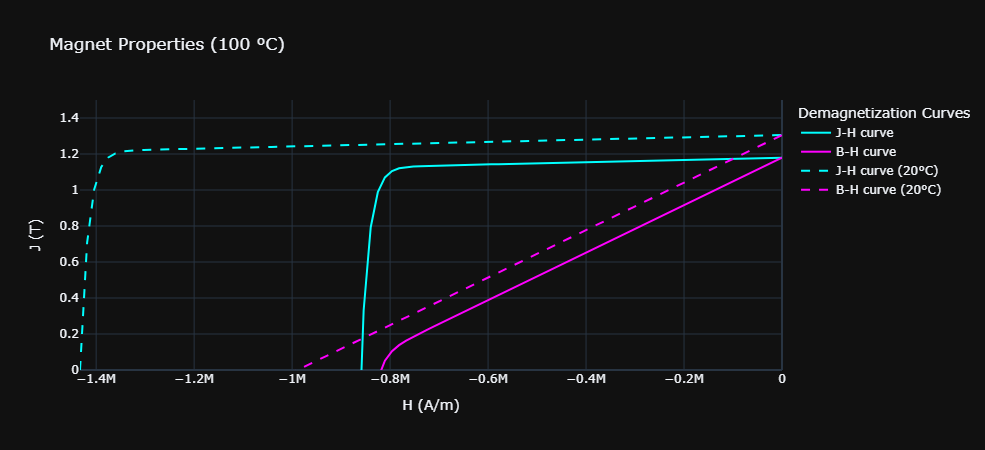
Remanence (Br): The flux density a magnet retains after the magnetising field is removed. Measured in Tesla. A higher Br means more flux per unit volume of magnet — allowing a smaller, lighter magnet for the same air-gap flux density.
Coercivity (Hcj): The intensity of the magnetic field required to reduce the magnet's magnetisation to zero. Measured in kA/m. A higher coercivity means the magnet is more resistant to demagnetisation — critical in motors where the stator field can act against the rotor magnets during fault conditions or overload.
Maximum energy product ((BH)max): The maximum amount of magnetic energy stored per unit volume of the magnet, measured in kJ/m³ (or MGOe in older datasheets). This is the figure of merit for how efficiently the magnet material stores magnetic energy. The grade number in the NdFeB naming convention refers directly to this value.
Reading the grade name
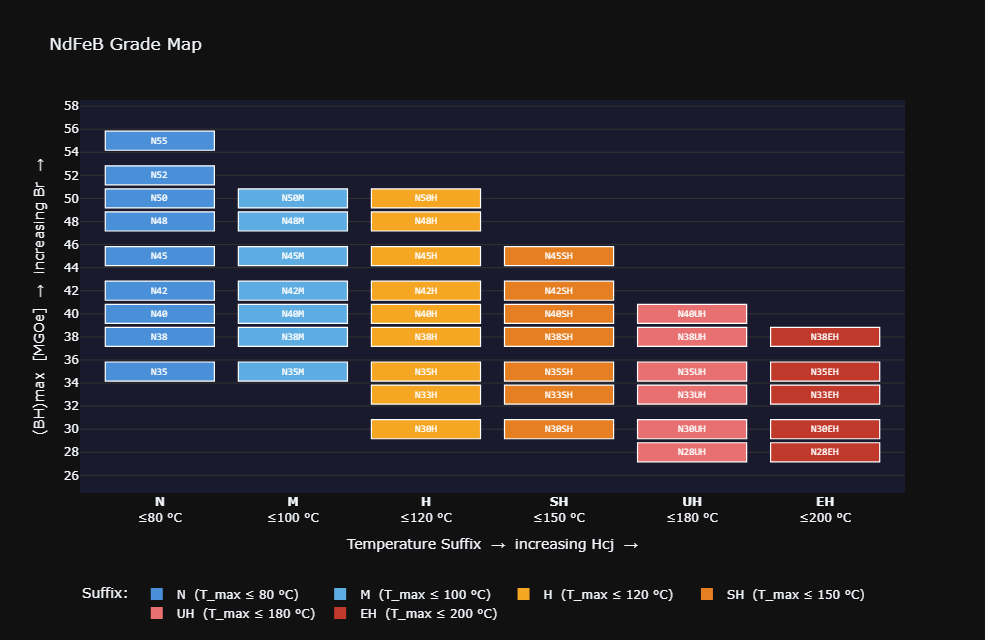
An NdFeB grade like N42SH contains two pieces of information: the number (42) gives the energy product, and the suffix (SH) gives the temperature class — that is, the maximum operating temperature up to which the coercivity remains adequate.
| Suffix | Max operating temp. | Coercivity level |
|---|---|---|
| (none) | 80 °C | Standard |
| M | 100 °C | Medium |
| H | 120 °C | High |
| SH | 150 °C | Super High |
| UH | 180 °C | Ultra High |
| EH | 200 °C | Extremely High |
| AH | 220 °C | Abnormally High |
Note that higher temperature class grades achieve their improved coercivity by substituting some of the neodymium with dysprosium or terbium. This increases Hcj but slightly reduces Br and significantly increases cost and supply chain risk, since dysprosium is a scarce heavy rare earth element.
The energy product vs coercivity trade-off
You cannot maximise both Br and Hcj simultaneously in a given alloy system. An N52 magnet has the highest energy product available commercially (~400 kJ/m³) but relatively low coercivity — making it suitable for room-temperature applications with no risk of demagnetisation. An N38EH magnet has lower energy product but survives continuous operation at 200 °C without irreversible demagnetisation.
For traction motors and servo drives, the operating temperature of the rotor magnets at maximum load — not just ambient temperature — determines the minimum required coercivity. Magnet temperature in a high-speed PMSM rotor can easily reach 120–160 °C under continuous rated load.
Selecting the right grade
Start with the operating temperature constraint: estimate magnet temperature at worst-case load and add a safety margin of 20–30 °C. This defines the minimum temperature class. Then, within that class, select the highest energy product grade your budget allows — it will give the most compact magnet for a given air-gap flux density. You can plot the demagnetisation curve of any grade at temperature in the magnets tool to check the margin.
For most EV and servo drive applications, N38SH or N40SH strikes a good balance — adequate temperature rating, high energy product, and reasonable availability. N52 is best reserved for applications where size and weight are critical and operating temperatures are well controlled.
Compare NdFeB grades and view demagnetisation curves
Browse Br, Hcj, and (BH)max data across grades and convert between SI and CGS units.