MMF harmonics in three-phase AC windings
A three-phase winding does not produce a perfectly sinusoidal magnetic field. The discrete placement of conductors in slots creates a stepped spatial distribution of magnetomotive force — and that staircase contains harmonics that have real consequences for motor performance.
What is magnetomotive force (MMF)?
Magnetomotive force is the driving quantity that pushes magnetic flux around a circuit. In a motor stator, MMF is produced by the current-carrying conductors in the slots. The spatial distribution of MMF around the air-gap circumference determines the shape of the magnetic field that the rotor sees.
An ideal stator would produce a perfectly sinusoidal MMF distribution — a single spatial harmonic at the pole-pair frequency p. Real windings, with conductors placed in a finite number of discrete slots, approximate this sine wave with a staircase function. Fourier analysis of that staircase reveals the harmonic content.
Where harmonics come from
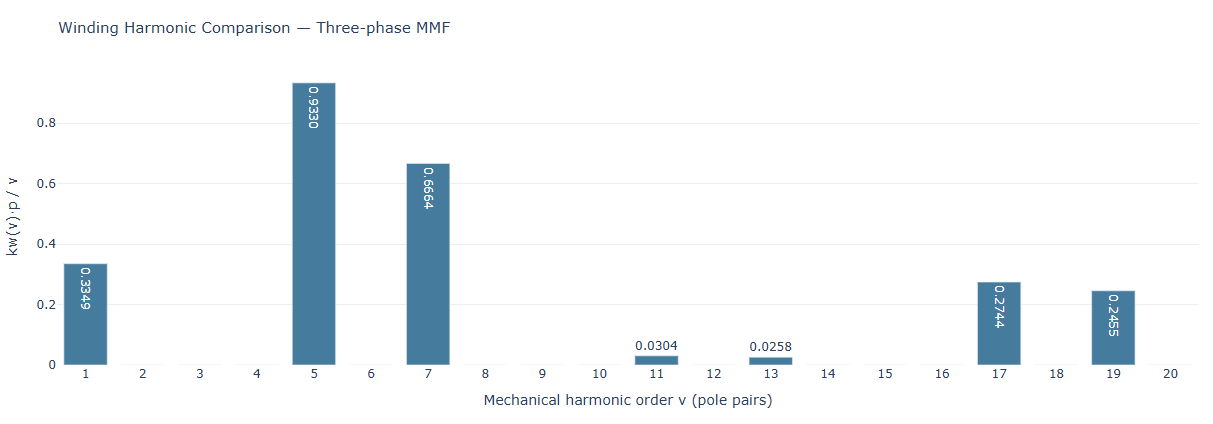
Each coil side in a slot contributes a rectangular pulse to the MMF distribution. The sum of all these pulses — weighted by the number of turns and the instantaneous current — forms the total MMF waveform. Because the pulses are rectangular and finite in number, the Fourier series of this waveform contains not just the fundamental (ν = p) but also higher spatial harmonics at ν = 5p, 7p, 11p, 13p, ... for a balanced three-phase winding.
Which harmonics survive in three-phase windings
The three-phase symmetry of the winding cancels certain harmonics automatically. Triplen harmonics (ν = 3, 9, 15, ...) cancel in a balanced three-phase system. Even harmonics cancel due to the half-wave symmetry of the winding. What remains are the odd, non-triplen harmonics: the 1st (fundamental), 5th, 7th, 11th, 13th, and so on.
| Harmonic order ν | Rotation direction | Present in 3-phase winding? |
|---|---|---|
| 1 (fundamental) | Forward | Yes — the useful working harmonic |
| 3, 9, 15 ... | — | No — cancelled by 3-phase symmetry |
| 5 | Backward | Yes |
| 7 | Forward | Yes |
| 11 | Backward | Yes |
| 13 | Forward | Yes |
Why harmonics matter
Torque ripple: Harmonic MMF components rotate at speeds different from the rotor. When they interact with the rotor's magnetic field, they produce pulsating torque components at specific frequencies. This is perceived as vibration and acoustic noise.
Rotor losses: In permanent magnet motors, harmonic fields induce eddy currents in the rotor magnets and back-iron as the stator harmonics sweep past. These losses heat the magnets — which is particularly problematic since elevated temperature reduces coercivity, increasing demagnetisation risk.
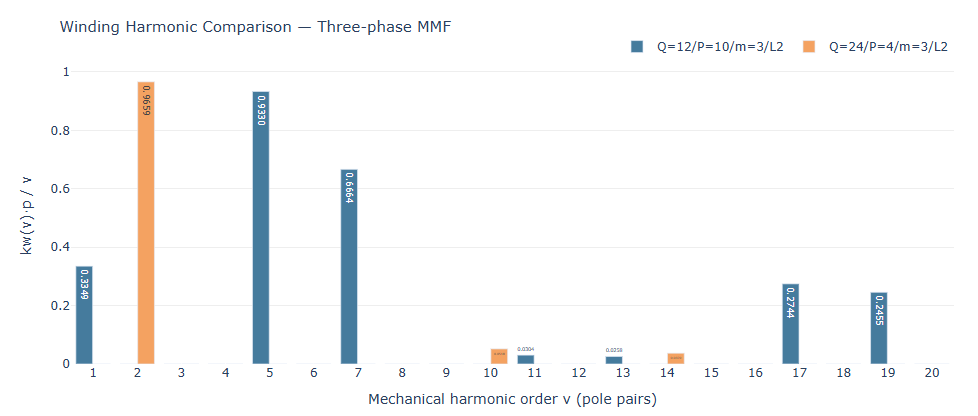
Sub-harmonics in FSCW: Fractional-slot concentrated windings can produce MMF harmonics at orders lower than the fundamental (ν < p). These sub-harmonics rotate faster relative to the rotor than the fundamental and cause disproportionately high rotor losses — a key design consideration when selecting slot/pole combinations.
The 12-slot/8-pole winding is popular partly because its dominant MMF harmonic is the working fundamental (ν = 4 pole-pairs), and the lowest sub-harmonic is at ν = 2 — relatively far from the working harmonic and with modest amplitude.
Reducing harmonic content
Distributed windings with more slots per pole per phase (higher q) produce smoother MMF waveforms with lower harmonic amplitudes — at the cost of longer end-turns. Short-pitching (chording) a winding selectively suppresses specific harmonics: a 5/6 pitch coil span nearly eliminates the 5th harmonic while leaving the fundamental mostly intact.
Visualise the MMF spectrum for any slot/pole combination
Plot MMF harmonics, compare winding configurations, and inspect the star-of-slots diagram interactively.